Two Traditions
The answers to these questions generally fall within two traditions, "Western" and "Eastern", which come from unrelated mythological currents and only share the name of dragon due to a questionable case of cultural translation: Westerners who encountered stories and images of Chinese and Japanese dragons sprung on the similarities to the European dragon and couldn't think of anything better to call them. And even then, in addition to cultural differences, dragons fall into a vast range of types even in one local mythology. Dragons can be everything from divine to satanic, animalistic to brilliant, personable to completely alien, and anywhere on the moral spectrum.
Other Variants
Besides those two aforementioned categorizations, dragons also have many different variants. Some appear in mythology and folklore, others are a more recent invention.
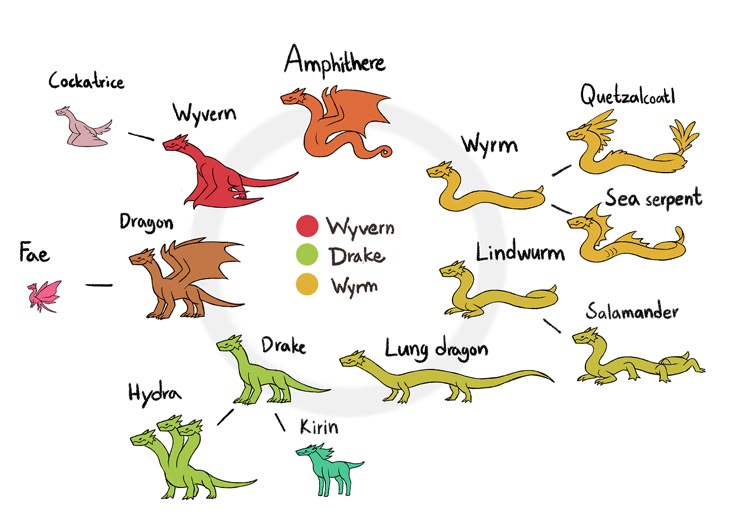
The most popular variation has been the wyvern, which resembles a bat, with clawed wings as forelimbs and two legs for hind limbs. Rivaling the wyvern is the Hydra from Greek mythology, which is often depicted as a flightless dragon-like water or swamp beast with one or more heads; for each head you cut off, two rapidly grow to replace it.
A drake is usually a creature related to dragons but smaller and less intelligent, equivalent to the relationship between humans and chimpanzees. More likely than dragons to come in multiple varieties adapted to different environments (e.g. the drakes that live around volcanos may be the only ones able to breathe fire). What they look like is variable, but most often they're differentiated from true dragons by having small or nonexistent wings; other examples might have a winged but two-legged body plan similar to wyverns. In some cases "drake" is simply an alternate name for dragons, or refers to young or male dragons in particular.
Very old (Greco-Roman, and a few medieval cultures such as Germanic-Nordic) dragons are presented as more serpentine than the more recent ones, if winged, the wings are usually their only limbs; and some were totally limbless, just enormous serpents. This type of dragon may be referred to as a wyrm (pronounced "worm"). Sometimes, however, "wyrm" will refer to a different type of dragon, or to particularly old and powerful ones, or may simply be a synonym for dragons in general.
Occasionally, winged but legless dragons may be referred to as amphipteres instead, a name derived from a kind of winged serpents traditionally used in French heraldry.
Another variant from heraldry is the lindwurm, a two-legged dragon with no other limbs. Variants include dragons that are armless bipeds or basically snakes with arms.
The wani are a type largely exclusive to Japan and nearby islands. Resembling some combination of a crocodile and/or shark, they often fit the class of a dangerous, powerful sea monster.
The imugi are largely exclusive to Korea, but similar myths do exist in Northern China. Largely resembling gigantic serpents, often water snakes or pythons, imugi are sort of a "proto-dragon".
The naga are found across central and southeastern Asia, into the Philipines, and can come in a wide variety of forms. The term has become a bit of an umbrella term, especially in English, but in broad strokes naga tend to be serpentine. Sometimes this means resembling gigantic snakes, other times the serpents have horns and fangs to give them a more draconic look, some have multiple heads, and others might be shapeshifters who can change their upper half to resemble a human.
Other reptilian or avian mixed mythological creatures, particularly the Sea Serpent, Basilisk, Cockatrice, and Quetzalcoatl, may be considered types of dragons or similar creatures in some works.
The commonalities between the different dragons' traits are often a hybridization of reptilian, mammalian, and avian features.
Etymology
History Overview
The word "dragon" entered the English language in the early 13th century from Old French dragon, which, in turn, comes from the Latin draco, meaning "huge serpent, dragon." Draco comes from the Ancient Greek word drakon, with the literal meaning of "one who stares" or "sharp-sighted". The Greek and Latin terms referred to any great serpent, not necessarily a mythological one.
Eastern languages tend to refer to them using different names (Japanese, for instance, refers to Western dragons as doragon and to Eastern ones as ryu or tatsu), and they are generally less interchangeable. Chinese dragons are referred to as long, with their regional variant in Korea being ryong and the aforementioned ryu in Japan.
Draconic creatures appear in virtually all cultures around the globe, and the earliest attested reports of draconic creatures resemble giant snakes. They are first described in the mythologies of the ancient Near East and appear in ancient Mesopotamian art and literature. Chronologically, the first dragons known in human history are (probably) Tiamat and Abzu from Mesopotamian mythology. They're both primordial deities who are lovers representing freshwater and saltwater. Their physical appearances aren't really described, but Tiamat is occasionally visualized as a giant serpent. She also gave birth to dragons, described as hybrids of serpents, lions, and birds.
Another early examples are the Behemoth and the Leviathan, two dragon-like monsters from the Tanakh (a.k.a. the Hebrew Bible). They're two apocalyptic monsters representing the primordial chaos on land and in the sea. Like Timat and Abzu, their appearances are vaguely described. The Leviathan is often interpreted as a sea serpent demon, with the monster itself derived from Lotan, a massive sea serpent in Ugaritic mythology. With the Behemoth, it seems to have some influence on Bahamut, an enormous winged sea monster (or a fish) from Arabian mythologies.
In Egypt, there are the serpents Apophis and Ouroboros. Apophis is also a deity of the underworld, embodying darkness and disorder, and bearing the titles of "the Lord of Chaos," "Serpent from the Nile," and "Evil Dragon." It is the greatest enemy of Ra, a deity of the Sun and the bringer of light. Apophis tries to eat Ra every night, thereby explaining the ancient Egyptian explanation of the day-night cycle. Meanwhile, Ouroboros, commonly depicted today as an ancient symbol of a snake/dragon eating its own tail, is a protective serpent that safeguards Ra during his journey through the underworld. It represents the cyclical nature of life, death, and rebirth, as well as the eternal cycle of the sun and the cosmos.
In Norse mythology, there's the Midgard Serpent, Jormungandr, a god-eating wyrm so enormous that he circles the Earth itself and can bite his own tail (an example of the aforementioned ouroboros symbol). Jormungandr is the second son of the god Loki and the giantess Angrboda, and is the archenemy of the storm god Thor. Thor would slay Jormungandr during the events of Ragnarok, but the World Serpent would also kill the god too. Stories about storm gods slaying giant serpents are a common motif in nearly all Near Eastern and Indo-European mythologies. Lotan, the serpent from the previously mentioned Ugaritic mythology, was also defeated by a storm god. Besides Jormungandr, the Norse also have the Nidhogg, a dragon that gnaws at the roots of the World Tree Yggdrasil. In the Volsunga saga, we have the dwarf-turned-dragon Fafnir. He was turned into a dragon through his greed for gold.
Vritra, from Hinduism, is the draconic personification of drought and the archenemy of the storm god Indra. In Mesoamerica, the most well-known dragon is the deity Quetzalcoatl, a flying, feathered serpent. There's also the dragon Xiuhcoatl, a small fire serpent wielded by the sun god Huitzilopochtli as a weapon. In the Inca empire, they had the two-headed serpent Amaru, who lived at the bottom of bodies of water. A common figure in most Australian Aboriginal cultures is the Rainbow Serpent, often associated with rain or water.
There are tons of dragons of varying shapes and sizes in Greek mythology. We have the classic multi-headed dragon, the Hydra; Ladon, the dragon who guards the garden of the Hesperides; the Colchian Dragon that guarded the Golden Fleece; Ketos, the sea serpent that threatens the princess Andromeda; and the chthonic serpent Python. There's also Typhon, the Father of Monsters, a monster whose status as a dragon is debatable. He is described as having arms that reached east and west (with a hundred dragon/serpent heads on each), enormous wings that blackened the sky, fire blazing from his eyes and mouth, sometimes a head like a dragon, sometimes with the head of a man, and sometimes with a hundred dragon heads. He does, however, follow the motif of a dragon fighting a storm (in his case, being Zeus).
In Europe, there are plenty of ballads about dragons causing problems for a region before being killed by a passing knight or saint. Some of these tales were metaphors for Christianity triumphing over paganism. There's also the dragon from Beowulf, which introduces the fire-breathing trait, which has since become iconic.
Dragons in China were prominent symbols as early as the Neolithic, representing strength, power, divinity, and fortune. They're commonly seen as deities of bodies of water, being all divine and fundamentally, which contrasts with their evil Indo-European monster counterparts. Notable dragons in China include Longshen, the Dragon King; Ao Guang, the Azure Dragon of the East China Sea; and Huanlong, the draconic form of the Yellow Emperor, the center of the cosmos, the element Earth, and the Chinese quintessence. In Japan, they have the Ryu, which are very similar to Chinese dragons: water-based and divine, and sometimes granting wishes. On the other hand, there are outliers like the sea serpent yokai, the Ikuchi, who sinks ships, and Yamata-no-Orochi, a legendary eight-headed snake monster. The latter was killed by the storm god Susanoo.